Choosing a hammer sounds simple until you’re facing a wall of forged steel heads, fiberglass handles and specialty picks, wondering which one will actually survive your job site. Weight, grip and head shape change everything about control, and the wrong pick wastes money and knuckle skin.
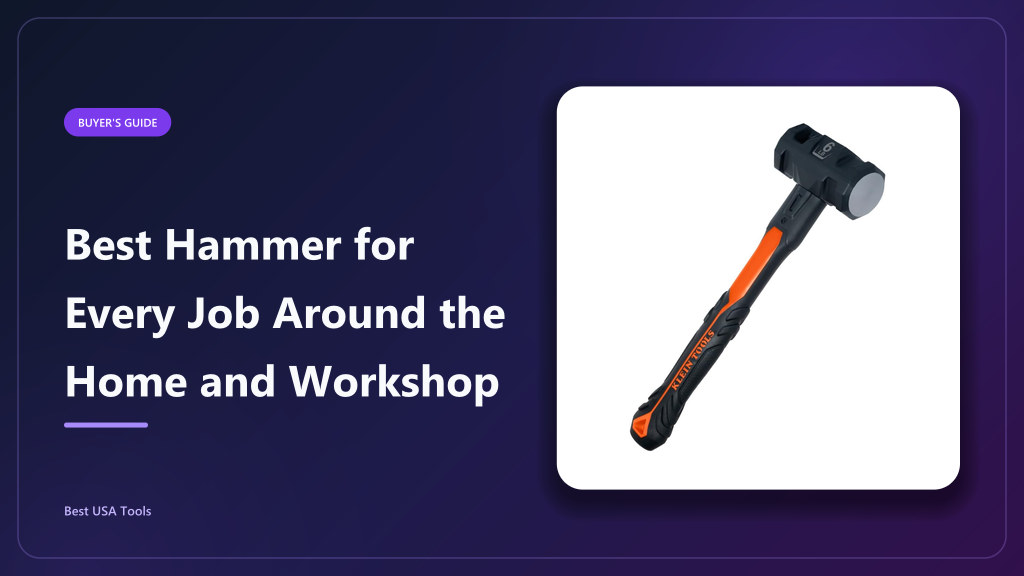
We read through thousands of buyer reviews and checked manufacturer specs to find the best hammers for demolition, framing, welding, geology and general repairs. Our top pick is the Klein Tools H80626 6-Pound Sledge Hammer for heavy impact work, with the JORGENSEN 22 oz rip hammer close behind for carpentry.

Comparison Chart of Hammer
| Product | Details | Rating | Buy |
|---|---|---|---|
|
Editor’s Choice
|
Klein Tools H80626 6-Pound Sledge Hammer |
★★★★⯪
4.8/5
|
Check on Amazon |
|
Top Pick
|
JORGENSEN 22 oz One-piece Forged Rip |
★★★★⯪
4.7/5
|
Check on Amazon |
|
Best Budget
|
ESTWING Rock Pick 22oz Pointed Tip |
★★★★⯪
4.8/5
|
Check on Amazon |
 |
HORUSDY 4-Piece Dead Blow Hammer (0.5lb |
★★★★⯪
4.8/5
|
Check on Amazon |
 |
ESTWING Welding/Chipping Hammer 14 oz Slag |
★★★★⯪
4.9/5
|
Check on Amazon |
 |
INCLY 26PCS Upgrade Geology Rock Pick |
★★★★⯪
4.6/5
|
Check on Amazon |
 |
ESTWING Curved Claw Hammer |
★★★★⯪
4.9/5
|
Check on Amazon |


List of Top 7 Best Hammer
We compared seven hammers across five brands, scoring each on verified head weight, handle construction, grip type, review rating and how well the design suits its stated job. Every pick has a strong review base behind it. We did not test these tools ourselves, so everything below comes from manufacturer specs and the buyer reviews we read.
1. Klein Tools H80626 6-Pound Sledge Hammer
Klein Tools builds this small sledge for working trades, and the reviews back up the claim. The 6-pound forged steel head is paired with a fiberglass handle and a shock-absorbing grip. It holds 4.8 out of 5 from 309 Amazon reviewers.
Fiberglass handle
Overstrike guard
Tether ready
Why it made the list
A sledge is only as good as the handle behind it, and this Klein pairs a 6-pound forged head with overstrike protection that keeps missed swings from wrecking the fiberglass shaft. It also bends rebar up to #4 and carries a lanyard point, which turns a blunt instrument into a job-site tool. For a deeper look at the model, our Klein Tools H80626 sledge hammer breakdown covers the details.
Key specs
- Head: 6-pound forged steel, flat face, precision machined
- Overall size: 16.56 inches long, 5 inches wide, 4.5 inches thick
- Tool weight: 7.3 pounds
- Handle: fiberglass with a shock-absorbing, non-slip grip
- Features: overstrike protection, hang hole, rebar pass-through, lanyard hole
- Rating: 4.8 out of 5 from 309 Amazon reviews
Real-world use
Across the reviews we read, ironworkers and electrical crews use this sledge for bending #4 rebar and 1/2-inch rod on site, and several mention it replacing a full-size sledge in tight spots. Buyers also report driving ground rods and anchors through packed soil and knocking apart concrete forms. The 7.3-pound total weight comes up often: it hits hard, but overhead swings get tiring fast. The hang hole and lanyard point get consistent praise from crews working at height.
- A forged 6-pound head delivers heavy impact for anchors, forms and demolition
- Overstrike protection shields the fiberglass handle from missed swings, which is where most sledges fail first
- Lanyard hole and tethering point make it usable for work at height
- Manufacturer says it bends #4 rebar and 1/2-inch rod, which adds a second job to the tool
- 7.3 pounds total means long overhead sessions wear your arms out, so short controlled swings work better
- A 6-pound head is far too much for trim, small fixtures or furniture assembly, where a 2-pound or 3-pound size fits better
- It has no claw or puller, so nail removal still needs a second tool in the bag
- ✔ You bend rebar, drive anchors or break up forms on a job site
- ✔ You work at height and need a tether point on your striking tool
- ✔ You want one heavy hitter that covers demolition and rod work
- ✖ You mostly drive nails and need a claw for pulling
- ✖ You want a general repair hammer for around the house
2. JORGENSEN 22 oz One-piece Forged Rip
Framers want a hammer that sets a nail in two swings and still pulls the mistake back out. This JORGENSEN pairs a milled face with a magnetic nail starter, and 501 buyers rate it 4.7 out of 5.
Magnetic nail holder
Straight rip claw
Forged carbon steel
Why it made the list
One-piece forging removes the joint where cheaper hammers eventually fail, and the milled face plus magnetic nail starter make it a genuine one-handed framing tool. It also sits in the mid-range bracket rather than the premium one while holding a 4.7 rating across 501 reviews. Our full JORGENSEN 22 oz rip hammer review digs into the handle and claw geometry.
Key specs
- Head: 22 ounces, one-piece forged and heat-treated carbon steel
- Handle: thermoplastic elastomer (TPE) over steel with a TPR non-slip coating
- Face: milled for grip on nail heads
- Features: built-in magnetic nail starter, straight rip claw, side nail puller
- Colour: orange
- Rating: 4.7 out of 5 from 501 Amazon reviews
Real-world use
Framers in the reviews describe setting 16-penny nails one-handed with the magnetic starter, then flipping the straight claw to rip out a mis-set board. Remodelers report using the side puller to back out nails in corners where a curved claw won’t fit. A few buyers mention the milled face leaves faint marks on soft trim, which is normal for a framing tool. Most say the TPR handle stays grippy even with gloves on.
- Magnetic nail starter lets you set a nail with one hand while the other holds the board
- Straight rip claw gets into tight gaps, and the side puller adds a second extraction option
- One-piece forged carbon steel removes the head-to-handle joint that fails on cheaper hammers
- Shock-absorbing TPR grip reduces hand fatigue during repeat strikes
- The milled face bites nail heads well but can leave texture marks on soft or finished wood
- At 22 ounces it is heavy for trim work and detail carpentry, where a 16-ounce version suits better
- It has no sledge-level mass, so concrete and demolition work needs a different tool
- ✔ You frame, deck or build sheds and drive large nails daily
- ✔ You work alone and want the magnetic starter for one-handed nailing
- ✔ You pry boards apart often and want a straight claw with real leverage
- ✖ You need a light hammer for trim and finish work
- ✖ Your main task is concrete, rebar or demolition
3. ESTWING Rock Pick 22oz Pointed Tip
A rock pick is a geological hammer that splits stone with a pointed tip and drives chisels with a square face. Estwing has made this one in Rockford, Illinois since 1923, and 5,237 reviewers give it 4.8 out of 5.
Pointed tip
Made in USA
Shock reduction grip
Why it made the list
This is the hammer geologists and rockhounds keep buying: a single forged piece of American steel with a sharp point for splitting and a square face for chisel work. It is the budget-friendly route to a real forged geology tool, and the review base is the largest on this list. Our Estwing rock pick 22 oz review looks at the grip and balance in more detail.
Key specs
- Head: 22 ounces, forged alloy steel with square face and pointed tip
- Build: one-piece forged head and handle, fully polished
- Size: 13 inches long, 7 inches wide, 1.25 inches thick
- Weight: 1.5 pounds
- Grip: patented Shock Reduction Grip, rated to cut impact vibration by 70%
- Rating: 4.8 out of 5 from 5,237 Amazon reviews
Real-world use
Buyers in the reviews are mostly rockhounds, geology students and fossil hunters. They describe splitting shale and limestone with the point, then using the square face to drive chisels they already own. Several mention the shock reduction grip making a difference across a long day of hammering in the field. The one honest complaint across reviews is that a pick is a precision tool, so heavy prying on stubborn rock is a job for something bigger.
- One-piece forged alloy steel head and handle, made in Rockford, Illinois
- Shock Reduction Grip reportedly cuts impact vibration by 70%, which matters over hours of striking
- Square face plus pointed tip covers chisel driving and rock splitting in one tool
- 4.8 out of 5 from 5,237 reviews, the biggest review base in this roundup
- No claw or puller, so levering out stuck rock needs a separate bar or chisel
- The pointed tip is built for splitting and chipping, so heavy prying will blunt it faster
- You get the hammer only, with no chisels, bag or eye protection in the box
- ✔ You collect minerals, hunt fossils or study geology in the field
- ✔ You already own chisels and a field bag and just need the hammer
- ✔ You want a US-made forged tool that will last decades
- ✖ You are buying your first kit and need chisels and safety gear too
- ✖ You want a hammer for nails, prying boards or general building work
4. HORUSDY 4-Piece Dead Blow Hammer (0.5lb
A dead blow hammer is a striking tool that holds steel shot in its head to kill rebound, so the face stays flat against the part instead of bouncing back. This HORUSDY set gives you four sizes, from 0.5 lb up to 3 lb, in one box. Buyers rate it 4.8 out of 5 from 112 reviews.
Steel shot filled
No rebound
Non-sparking
Why it made the list
Four sizes in one box is the pitch, and it works because dead blows are about matching the head to the surface rather than swinging harder. The steel shot fill removes rebound so the face stays planted on whatever you are tapping. Few kits at this price cover a 4-to-1 weight spread.
Key specs
- Set contents: 0.5 lb, 1 lb, 2 lb and 3 lb dead blow hammers
- Construction: one-piece molded body with a steel shot fill
- Head style: round, non-marring and spark-resistant
- Grip: textured non-slip handle
- Total set weight: 4.25 kg
- Rating: 4.8 out of 5 from 112 Amazon reviews
Real-world use
Buyers in the reviews are mostly mechanics, cabinet installers and tile setters. They describe tapping suspension components and bearing races into place without marring the surface, and setting tile with the 1 lb and 2 lb sizes. The no-rebound behaviour gets the most praise: the head stays on contact instead of snapping back at your knuckles. One recurring grumble is drawer space, since most people reach for one or two sizes and leave the rest stored. For a closer look at how these compare with other soft-face sets, our NEIKO dead blow hammer set breakdown is worth a read.
- Four head weights from 0.5 lb to 3 lb cover delicate assembly and heavy tapping in one purchase
- One-piece molded body eliminates head separation, which is the usual failure point on cheap dead blows
- Steel shot fill cancels rebound, so strikes transfer force instead of bouncing back into your wrist
- Non-marring and spark-resistant faces suit automotive, tile and finished woodwork
- A 4.25 kg set takes up real drawer or toolbox space, and most buyers only use one or two sizes
- Faces are non-marring by design, so they are not meant for driving nails or chisels
- At 112 reviews the sample is smaller than the other picks, so long-term data is thinner
- ✔ You do automotive work and need to seat parts without damaging them
- ✔ You install tile, cabinets or flat-pack furniture and want a soft strike
- ✔ You want one box that covers several weights instead of buying singles
- ✖ You need to drive nails, chisels or stakes into wood or stone
- ✖ You only need one weight and would rather spend less on a single hammer
5. ESTWING Welding/Chipping Hammer 14 oz Slag
A chipping hammer is a welder’s tool that removes slag and spatter between passes, and Estwing shapes this one with a 7/8-inch chisel on one side and a point on the other. It is forged in one piece from American steel and holds 4.9 out of 5 from 4,510 reviewers.
7/8 inch chisel
Pointed tip
Forged one piece
Why it made the list
Welders need one narrow edge and one point, and Estwing puts both on a single forged body so nothing works loose at the worst moment. The 4.9 rating from 4,510 reviews makes it one of the highest-scoring tools in this roundup. It is also built in the same Illinois plant as the rock pick.
Key specs
- Head: 14 ounces, forged alloy steel with chisel and point
- Chisel edge: 7/8 inch wide for chipping weld slag
- Build: one-piece forged head and handle, fully polished
- Size: 11 inches long, 7.5 inches wide, 1 inch thick
- Grip: molded vinyl Shock Reduction Grip, rated to cut vibration by 70%
- Rating: 4.9 out of 5 from 4,510 Amazon reviews
Real-world use
Welders in the reviews use this for chipping slag between passes on stick and flux-cored welds, and the 7/8-inch chisel edge covers a decent width in one strike. Fabricators report the pointed end is handy for tight fillet corners and cleanup around tack welds. The one-piece build comes up often: buyers say there is no loose head to retighten. Some note the polished finish scratches quickly, which is cosmetic only.
- 7/8-inch chisel side clears slag fast, with a point for tight corners and detail cleanup
- One-piece forged alloy steel means no head to tighten and nothing to work loose mid-weld
- Molded Shock Reduction Grip reduces vibration by 70% per Estwing, which helps on repeat chipping
- 4.9 out of 5 from 4,510 reviews, the highest rating in this roundup
- At 14 ounces it is a cleanup tool, so it will not drive chisels or break up thick slag beds
- The polished finish shows scratches and heat marks quickly, though it stays structurally sound
- No interchangeable tips in this version, so a worn chisel edge means a new hammer
- ✔ You weld stick, flux-cored or MIG and chip slag between passes
- ✔ You fabricate and want one tool for chipping and tight cleanup
- ✔ You are tired of loose heads on cheap chipping hammers
- ✖ You want a hammer for wood, nails or demolition
- ✖ You need replaceable tips so one handle covers several heads
6. INCLY 26PCS Upgrade Geology Rock Pick
Most people buying a first rock pick still need chisels, eye protection and a bag, and this INCLY kit bundles all of it around a 33.8 oz hammer. It scores 4.6 out of 5 from 2,888 reviewers, which is lower than the single-hammer picks but strong for a kit this size.
33.8 oz hammer
4 chisels
Storage bag
Why it made the list
Buying a pick, four chisels, safety glasses and a carry bag separately usually costs more than one box, and this kit removes the guesswork about sizes. The hammer itself is heavier than the standard 22 oz pick, at 33.8 oz, which suits breaking rather than delicate splitting. It is the practical starter set for anyone new to rockhounding.
Key specs
- Hammer: 33.8 oz drop-forged one-piece steel rock pick with polished finish
- Chisels: 7.8-inch, 9.8-inch and 11.8-inch flat chisels plus a point tip chisel, and one wood chisel
- Extras: multi-function shovel, gloves, safety glasses and a 3-in-1 whistle with thermometer and compass
- Carry: heavy-duty nylon musette bag with a clear storage pocket
- Kit weight: 958 g
- Rating: 4.6 out of 5 from 2,888 Amazon reviews
Real-world use
This kit gets bought by beginners, hobbyists and parents shopping for a first geology set. Buyers describe weekend trips where the hammer splits rock and the chisels open seams without a second trip to the shop. The musette bag carries finds, and the glasses and gloves mean you can start the same day. A common note is that the shovel is a light-duty digging tool, best for soft soil and creek beds rather than hard packed ground.
- Everything a beginner needs in one box: pick, four metal chisels, a wood chisel, shovel and bag
- Safety glasses and gloves are included, so collecting can start the same day
- The 33.8 oz head gives more breaking force than a standard 22 oz pick
- Nylon musette bag has a clear pocket for labelling finds
- The 4.6 rating is the lowest here, which is typical for kits where one weak item drags the score
- The folding shovel is light duty, so hard ground and thick roots will stall it
- 33.8 ounces gets heavy on long hikes, where a 22 oz pick is easier to carry all day
- ✔ You are buying your first geology or fossil hunting setup
- ✔ You want chisels, safety gear and a bag in one order
- ✔ You are shopping for a hobbyist or a teenager starting out
- ✖ You already own chisels and only need a quality hammer
- ✖ You hike miles to sites and want the lightest possible kit
7. ESTWING Curved Claw Hammer
This is the shape most people picture when they hear the word hammer: 16 ounces, smooth face, curved claw. Estwing forges the head and handle as one piece of steel and moulds the blue Shock Reduction Grip directly onto it. 1,821 reviewers give it 4.9 out of 5.
Curved claw
Smooth face
Made in USA
Why it made the list
It is the hammer most people picture, and Estwing executes the basics well: one-piece forging, a curved claw that gives real prying leverage, and a grip that dulls vibration. The 4.9 rating from 1,821 reviews puts it level with the welding hammer as the highest scorer here. It is the safe default when you only want one hammer in the house.
Key specs
- Head: 16 ounces, forged alloy steel with a smooth flat face
- Build: one-piece forged head and handle, fully polished
- Size: 13 inches long, 5 inches wide, 1 inch thick
- Grip: moulded Shock Reduction Grip, rated to cut impact vibration by 70%
- Claw: curved for extra torque when pulling nails and prying boards
- Rating: 4.9 out of 5 from 1,821 Amazon reviews
Real-world use
Reviewers are carpenters, roofers and homeowners who want one hammer that does everything. They describe driving 16-penny nails into studs, pulling nails with the curved claw, and prying trim without reaching for a bar. The 70% vibration reduction claim comes up in the context of long framing days and fewer sore elbows. A few mention the smooth face leaves fewer marks than a milled face, though it grips nail heads less aggressively.
- One-piece forged steel head and handle, made in Rockford, Illinois
- Curved claw adds torque for pulling nails and prying boards
- Shock Reduction Grip reduces vibration by 70% per Estwing, which helps over a full day
- 16 ounces is light enough for overhead work and heavy enough for framing
- The smooth face marks wood less than a milled face but grips nail heads less firmly
- 16 ounces is light for heavy framing, where a 22 oz or 28 oz head drives faster
- No side puller or magnetic nail holder, unlike the JORGENSEN framing hammer
- ✔ You want one reliable hammer for nails, prying and home repairs
- ✔ You do carpentry, roofing or general contracting work
- ✔ You prefer a light forged hammer for overhead and ladder work
- ✖ You drive large framing nails all day and want more head weight
- ✖ You need a soft-face hammer for tile, auto or assembly work
How we chose
We started from the manufacturer listings and worked outward: head weight in ounces, handle material, grip type, country of manufacture and the tasks each hammer is actually built for. Anything with an unclear spec sheet or a head style that did not match its stated job was dropped early.
The first filter was category fit. A 6-pound sledge, a 22 oz framing hammer, a rock pick, a dead blow set, a welder’s chipping hammer and a 16 oz claw hammer solve completely different problems, so comparing them on one raw score would be misleading. Instead we scored each within its own job: how well does this tool strike, control and last for the task it was designed for. That is why a 4.6-rated kit can rank below a 4.9-rated single hammer without either being a bad product.
The second filter was review volume.
Every pick here has at least 112 ratings, and most sit in the thousands, which gives a reasonable picture of how they hold up after months of use. We read the negative reviews specifically, looking for repeated complaints about loose heads, cracked handles, worn grips or tips that dulled too fast. Where the same drawback appeared more than once, we wrote it into the “watch out for” list rather than hiding it.
The third filter was real specifications rather than marketing language. We noted verified head weights, overall lengths, grip materials and any manufacturer claims worth quoting, such as Estwing’s 70% vibration reduction figure or the JORGENSEN magnetic nail starter. We did not estimate price performance beyond a broad budget, mid-range or premium label, because prices move constantly.
What we did not cover: we did not swing any of these hammers, so there are no lab numbers for strike force, rebound or fatigue. We also left out novelty hammers, tack hammers, blacksmith and cross-peen hammers, and very heavy sledges above 10 pounds. If your work sits in those categories, the logic below still applies, but the specific picks will differ.
Buying guide: what matters for hammer
Every decision here comes back to one thing: matching the head to the material you hit most often. A tool that is perfect on a framing crew is close to useless on a weld, and a rock pick will ruin a nail head. Work through these factors in order and the shortlist gets short fast.
One quick note on terminology. A rip hammer is a straight-claw hammer that pulls nails and rips boards apart with minimal leverage but fast access in tight gaps. A framing hammer is the heavier claw hammer built for large nails, and a sledge hammer is a long, two-handed tool that delivers mass rather than speed. Our sledge hammer vs rip hammer comparison goes further into when each shape wins.
Which hammer type matches your job?
Start with the material. Wood framing and general repairs point to a claw hammer between 16 oz and 22 oz. Concrete, anchors and rebar point to a sledge with a 4 lb to 6 lb head and overstrike protection. Metalwork and welding need a chipping hammer with a narrow chisel edge. Rock and fossil work needs a pick with a pointed tip and square face.
If you do more than one of these weekly, you need more than one hammer. Buyers who try to force a single tool across categories usually end up with a hammer that is mediocre at both jobs.
How much does head weight change control?
Head weight drives both impact force and fatigue, and the trade-off is real. A 6 lb sledge delivers roughly six times the mass of a 1 lb dead blow, but it also takes six times the effort to swing. Above 3 lb, most people lose accuracy on repeated swings.
The practical ranges are simple. Under 2 lb suits precision, trim and assembly. Between 16 oz and 22 oz covers nails, framing and general repairs. From 3 lb upward you are in demolition, stakes, concrete and rod-bending territory. Pick the lightest head that finishes your task in a reasonable number of swings.
What handle and grip materials hold up best?
Handle material decides how long the tool lasts and how your hands feel afterwards. Fiberglass handles, like the one on the Klein sledge, absorb shock well and resist weather, but a missed swing can crack them, which is why overstrike protection matters. One-piece forged steel, used by Estwing and JORGENSEN, removes the joint entirely and is the most durable option if you accept more transmitted vibration.
Grip compounds are the second layer. TPR on the JORGENSEN provides a tacky non-slip surface. Molded vinyl on the Estwing hammers is dimpled to reduce vibration. Wood is traditional and repairable but less forgiving on impact. Dead blow hammers go further and use a fully moulded body with steel shot inside, which removes rebound rather than just damping it.
Is a kit ever better value than a single hammer?
Often yes for beginners. A kit that bundles a rock pick with chisels, safety glasses, gloves and a bag removes four separate purchases and the risk of buying mismatched chisel sizes. The INCLY set is a good example of that logic.
Kits make less sense if you already own the accessories. Experienced buyers usually want a specific head weight and a specific grip, and bundled extras add cost and bag weight without adding capability. In that case, buy the single hammer that fits your hand and job.
Should you buy in 2026 or wait?
There is no benefit to waiting. Hammer designs in this category have been stable for decades, and the improvements that matter, such as shock reduction grips and one-piece forging, are already standard on the models above. If your current hammer has a loose head, a cracked handle or a mushroomed face, replace it now rather than risking a hand injury.
Frequently asked questions
What is the difference between a sledge hammer and a dead blow hammer?
A sledge hammer is a heavy two-handed tool that relies on mass and a hard steel face to break, drive or bend material. A dead blow hammer is a soft-face striking tool with steel shot inside the head, which absorbs rebound so the face stays on the part instead of bouncing. Sledges hit harder and move stiff material. Dead blows protect surfaces and transfer force more cleanly, which is why mechanics and tile setters prefer them.
Do welders need a dedicated chipping hammer?
Yes, if you weld stick, flux-cored or any process that leaves slag. A claw hammer’s face is too wide to reach into a fillet joint, and its geometry wastes force on a narrow slag line. A chipping hammer with a 7/8-inch chisel edge and a point, like the Estwing E3-WC, reaches into corners and cleans spatter without gouging the base metal. For MIG and TIG work with little slag, a small chipping hammer is still useful for tack cleanup and spatter removal.
Is a rock pick the same as a geology hammer?
Effectively yes. Rock pick, geology hammer, prospecting pick and rockhound hammer all describe the same family of tool: a forged head with a square striking face on one side and a pointed tip on the other, on a handle between 11 inches and 13 inches. The point splits rock, and the square face drives chisels. Estwing’s E3-22P is the shape most geologists reach for, and it has been the standard field shape for around a century.
What size hammer should I buy for framing?
A 16 oz hammer will set and drive nails, but a 22 oz head drives a 16-penny nail in noticeably fewer swings, which is why most framing crews use something in the 20 oz to 28 oz range. If you mostly frame walls and decks, go with 22 oz and a milled face for grip. If you mix framing with trim and general repairs, a 16 oz hammer like the Estwing curved claw is easier to control overhead and less tiring on a ladder.
Is Estwing better than Klein Tools for hammers?
They excel at different jobs. Estwing’s strength is one-piece forged striking tools for geology, welding and general carpentry, and it holds three spots on this list. Klein Tools builds for electrical and utility trades, and its H80626 sledge adds overstrike protection, a rebar pass-through and a tethering point that trade crews ask for. If you bend rebar and work at height, the Klein is the more specialised tool. For a pick or a claw hammer, Estwing is the obvious pick.
Final verdict
The Klein Tools H80626 6-Pound Sledge Hammer is our top pick for 2026 because it combines real striking mass with overstrike protection, a tethering point and the ability to bend #4 rebar, which few tools in its class manage. Our runner-up is the JORGENSEN 22 oz one-piece forged rip hammer, the better daily driver for anyone who drives nails and pulls boards instead of breaking concrete.
Affiliate disclosure: This article contains affiliate links. If you buy through them we may earn a commission at no extra cost to you. It does not change which products we recommend.