When you’re specifying a new separation column, the choice between a tray tower and a packed tower carries real weight. It affects performance, maintenance access, pressure drop, turndown capability, and how the vessel itself gets built. Understanding the nuances of each design will help you ask better questions of your fabricator, avoid costly mismatches, and keep your project on schedule. Shops experienced in trayed tower fabrication know these differences aren’t just academic. They drive every internal fitting, weld sequence, and quality check from the first plate cut to final inspection.
This post breaks down how each column type works, where each design fits best, and what the fabrication process looks like for each one.
The Basics: What Each Design Is Doing
Both tray towers and packed towers accomplish the same fundamental task. They bring rising vapor into contact with descending liquid so that lighter components separate from heavier ones. The difference is in how that contact happens.
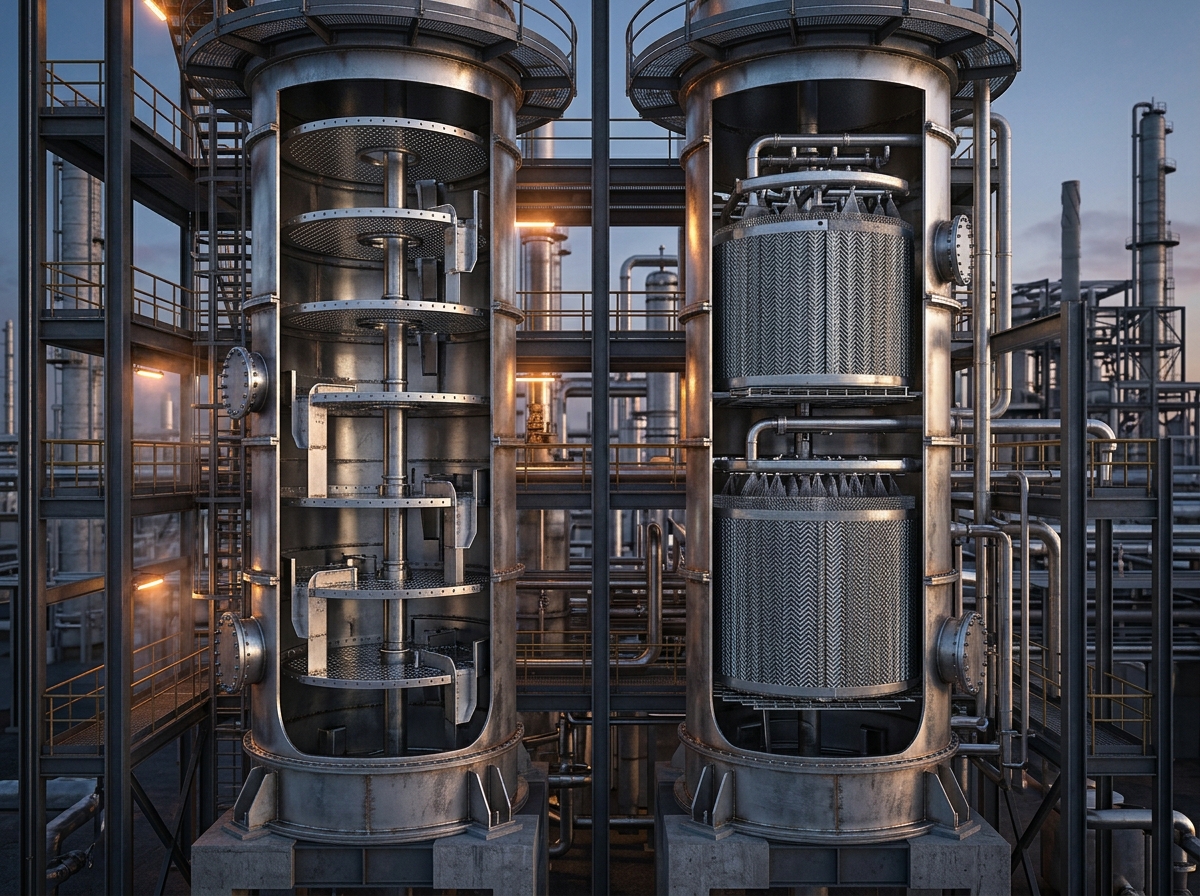
A tray tower uses a series of horizontal stages stacked inside the shell. Liquid flows across each tray, drops through a downcomer to the tray below, and vapor rises through openings in the tray deck. Each tray acts as a discrete separation stage. The number of trays, their spacing, and their geometry determine how much separation the column can achieve.
A packed tower replaces those horizontal stages with a bed of material, either random packing or structured packing. Vapor moves upward through open channels in the packing while liquid flows down over its surface. Separation happens continuously throughout the bed rather than at distinct stages. The height and type of packing determine the number of theoretical separation stages the column provides.
Both work. The question is which one works better for your specific process conditions.
When Tray Towers Make More Sense
Tray columns tend to earn their place when operating flexibility is a priority. If your plant runs at varying throughput, or if feed composition shifts across seasons or production campaigns, valve trays in particular can accommodate a wider operating range before performance starts to fall off. Sieve trays are simpler and more economical, but they’re more sensitive to low vapor rates. Valve trays adjust dynamically to changing conditions, making them a strong choice when turndown matters.
Fouling service is another place where trays often win. Open tray decks with generous tray spacing give maintenance crews reasonable access to inspect and clean individual stages. You can remove and replace damaged trays without disturbing the entire column. In services prone to polymerization, scale buildup, or coking, that access is worth a lot.
Larger column diameters also favor tray designs. Once you’re working with towers above roughly 24 inches in diameter, installing structured packing becomes more complex and the cost advantage of packing narrows. Tray columns in larger diameters are well-understood and straightforward to maintain.
Multiple feed points or side draw nozzles are easier to manage with trays as well. Each tray is a known stage, so routing feeds or withdrawals to a precise point in the separation sequence is a direct exercise. With packed beds, you need to account for where the bed begins and ends, where redistributors sit, and how liquid distribution changes after each draw point.
When Packed Towers Make More Sense
Packed columns earn their place where pressure drop is a critical constraint. This comes up most often in vacuum distillation, where any pressure rise toward the bottom of the column translates directly into higher boiling temperatures. For heat-sensitive products, that temperature rise can cause degradation before separation is complete. Structured packing can provide much lower pressure drop per theoretical stage than trays can, which makes it the preferred choice in many vacuum services.
Smaller column diameters also favor packing. Below roughly 18 to 24 inches, installing trays becomes mechanically difficult. The physical space for downcomers, weirs, and tray support rings becomes very tight. Random packing can fill small-diameter columns effectively and provides reasonable separation without the fabrication complexity.
Heat-sensitive or high-value products also benefit from the lower liquid holdup that packed columns typically offer. Less liquid in the column at any given time means less inventory at risk if a process upset occurs. That can matter a great deal in pharmaceutical, fine chemical, and specialty solvent applications.
Corrosive service requiring non-metallic internals is one more area where packing provides an advantage. Ceramic or polymeric packing can be used where the process chemistry would degrade metallic tray decks and hardware, allowing the steel shell to handle the pressure and temperature load while the internals resist the corrosive media.
How the Fabrication Differs
This is where the conversation becomes especially relevant for procurement and engineering teams. Choosing between a tray tower and a packed tower is not only a process decision. It directly shapes what the fabricator has to do and how complex the work becomes.
For a trayed tower, the shell fabrication work centers on precision. Tray support rings are typically welded to the inside of the shell at each tray location, and those rings have to be level, properly spaced, and positioned at exactly the right elevation throughout the full column height. In a tall vessel, that means maintaining tight dimensional tolerances across many weld passes as the shell grows. Any deviation in ring elevation or levelness creates problems when the trays are installed. Vapor and liquid distribution on each stage depends on the tray sitting flat within the shell.
Nozzle placement matters just as much. Manway locations have to align with the tray spacing so maintenance crews can actually reach the trays they need to work on. Feed nozzles, side draw nozzles, and instrumentation connections all have to land at the right elevation relative to the tray layout. A misplaced nozzle can’t simply be repositioned without reconsidering the tray numbering and feed stage logic.
Weld distortion management is also a real consideration in tall trayed towers. As the shell courses are welded together and the support rings are welded in, heat input can introduce slight out-of-roundness or axial bow into the shell. A fabricator who understands this plans the weld sequence accordingly and monitors shell geometry throughout the build.
For a packed tower, the fabrication work shifts toward a different set of requirements. The shell still needs careful construction, but the internal attachments change. Instead of many tray support rings at close intervals, the fabricator installs packing support grids and hold-down grids at the top and bottom of each packed bed. Liquid distributor brackets, redistributor support rings, and vapor distributor components all need to be positioned with care. The liquid has to enter the packing evenly or the bed underperforms regardless of how good the packing itself is.
Packed towers also tend to be simpler from a sheer count of internal attachments, which can reduce fabrication hours. But that doesn’t always mean they’re easier to build well. Liquid distributors in particular are precision components. A poorly fabricated or misaligned distributor will cause channeling in the bed, sending most of the liquid down one side and leaving the rest of the packing dry.
Material selection plays into the fabrication approach for both designs. Carbon steel works well in many hydrocarbon and industrial applications. Stainless steel is common where corrosion resistance or product purity requirements demand it. Some processes call for clad plate construction, where a carbon steel shell carries the structural and pressure load while a corrosion-resistant alloy liner protects the process side. All of these choices affect how the shop sequences the work, what welding procedures apply, and what testing and inspection steps are required before the vessel ships.
What This Means at the RFQ Stage
When you’re requesting quotes for either type of column, giving the fabricator a complete picture upfront saves time and reduces risk for both parties. Key information to include goes beyond diameter and shell length.
For trayed towers: specify tray type, tray spacing, the number of trays, downcomer clearance requirements, tray support ring dimensions, manway size and spacing, and nozzle elevations relative to tray numbers.
For packed towers: specify the bed height, packing type and size, support grid and distributor details, redistributor locations, nozzle placements relative to bed tops and bottoms, and any requirements for liquid collector design.
In both cases, ASME code requirements for the pressure-bearing shell apply regardless of the internals. The vessel has to be designed and documented to the applicable code division, inspected by an authorized inspection agency, and stamped accordingly. Those requirements don’t change based on whether trays or packing fill the shell.
The Bottom Line
Tray columns and packed columns each have a place in process design, and neither is universally better. The right choice depends on pressure drop tolerance, operating range, fouling potential, column diameter, maintenance philosophy, and the nature of the separation being performed.
What does change significantly between the two is what the fabricator has to do to build the vessel correctly. Tray tower work requires precise internal attachment layout, careful nozzle placement relative to tray elevation, and close attention to shell roundness and distortion. Packed tower work requires equally careful attention to distributor alignment and packing support design.
Knowing which design you’re building and understanding why those fabrication details matter puts you in a much better position to evaluate vendor proposals, review shop drawings, and stay ahead of issues before they affect your schedule.