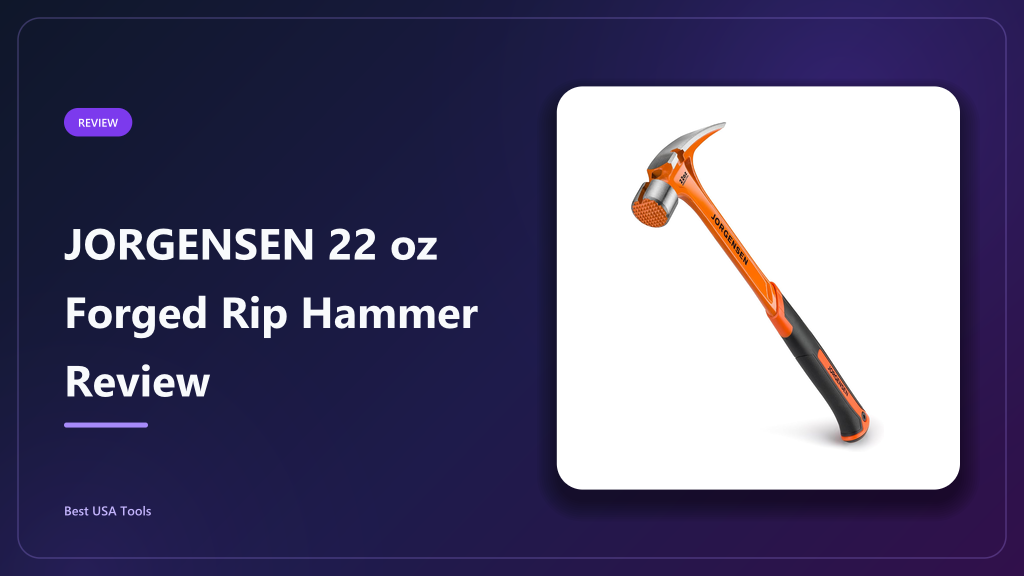
This JORGENSEN 22 oz One-piece Forged Rip review focuses on a budget framing hammer with a 4.7 out of 5 rating across 501 Amazon reviews. Jorgensen built it from a single piece of forged carbon steel, added a milled striking face, a magnetic nail starter and a straight rip claw, then wrapped the handle in a shock absorbing TPR grip. On paper it covers the basics a general carpenter asks for.
Bottom line: it’s worth buying if you want a heavy-headed hammer for framing and demolition without moving into premium territory. Skip it if your work is mostly light indoor jobs, because 22 oz is a lot of weight to swing at picture hooks and flat-pack furniture. The card below has the headline details.

1. JORGENSEN 22 oz One-piece Forged Rip
The Jorgensen 22 oz rip hammer is the heaviest of three sizes in this family, and Jorgensen aims it at framing, remodeling and demolition rather than light household repairs. It carries a 4.7 out of 5 rating from 501 Amazon reviews, which is a strong score for a budget tool. Here’s how the specifications and the buyer feedback line up.
What it is
A rip claw hammer is a striking tool whose straight claw is built for levering nailed boards apart and pulling nails, rather than the curved claw you see on a finishing hammer. This Jorgensen model sits in the mid-weight, budget corner of that category: a 22 oz head, one-piece forged carbon steel, an orange TPE handle. Rivals such as Estwing, Vaughan and Stiletto charge more for similar head weights, though several of them bring American manufacturing and longer track records. The model number is 60203, and at the time of writing it sat at #15,445 in Amazon’s Tools & Home Improvement ranking, which suggests steady rather than viral demand.
Setup and first impressions
Reports from the reviews we read follow a similar script. The hammer arrives boxed and in stock, with a thin film of oil on the forged head that wipes off with a rag. The orange handle is the first thing buyers mention, and a few say it makes the tool easier to spot in a cluttered truck bed or on a dark shelf.
Weight is the second theme. Several reviewers note that the 22 oz head feels heavier in hand than the number suggests, and more than one mentions reaching for a lighter hammer on ladder work. Handle texture draws mixed comments: most describe it as secure and comfortable, a minority call it too thick for gloves-off use.
The magnetic nail starter is the feature people test first. The consensus across the reviews we read is that it holds a common nail upright well enough to start it one-handed. There’s no assembly and no break-in period. It feels like a hammer from the first swing.
| Model number | 60203 |
| Head weight | 22 oz (about 624 g) |
| Head material | One-piece forged, heat-treated carbon steel |
| Face style | Milled |
| Claw | Straight rip claw with built-in side nail puller |
| Handle material | Thermoplastic elastomer (TPE) |
| Grip | Ergonomic non-slip TPR |
| Nail starter | Built-in magnetic holder |
| Colour | Orange |
| Sizes in the range | 16 oz, 20 oz, 22 oz |
Day-to-day use
Striking nails with a milled face
A milled face is a striking surface cut with a shallow cross-hatch pattern that grips the nail head instead of glancing off it. Jorgensen machines that texture into the 22 oz head, and buyers consistently mention fewer slipped strikes when driving framing nails. The magnetic starter sits in a groove behind the face and holds a nail upright, so you can set it with one hand while the other holds the board or the ladder.
It works best with common round-head nails. Smaller finish nails sit looser in the magnet, and thin brads barely register at all. The trade-off is cosmetic: a milled face leaves faint crescent marks around the nail head, so keep this hammer away from visible trim and stained decking.
Pulling, prying and the rip claw
A rip claw is the straight, chisel-tipped claw on this tool, and it’s the reason the hammer earns its place on a demolition day. Because the claw sits close to the line of the handle, you can drive it into the gap between two nailed boards and lever them apart with your body weight behind it.
The reviews we read mention the tips being thin enough to slide under nail heads without a lot of hunting around. Jorgensen also fits a side nail puller, a small notch near the head for gripping a nail shank at an angle. Buyers say it’s handy in tight spots where the main claw can’t get a bite, such as pulling nails out of a stud pocket or near a corner.
Grip, balance and vibration
TPR is a rubbery thermoplastic that keeps its grip when your palms get sweaty, and Jorgensen coats the TPE handle with it. The grip has a slight curve and a flared end, which helps the hammer stay put when you set it down on a ladder or a joist. Buyers describe the surface as secure in bare hands and in light work gloves.
Balance is a matter of taste. Several reviewers call the hammer head-heavy, which suits driving force but takes adjustment for finer placement. The manufacturer claims the grip absorbs shock and reduces fatigue, and buyers generally agree it’s comfortable over a long day, though nobody is calling it a vibration miracle.
Is the 22 oz head too heavy for overhead work?
Twenty-two ounces is about 624 grams, which is squarely in framing hammer territory and clearly heavier than the 16 oz hammer most DIYers own. Buyers who spend the day nailing at chest height or below tend to like the extra mass, because it needs less swing speed to drive a nail flush.
Move to overhead work, such as nailing up ceiling joists or sheathing, and the same weight becomes tiring fast. If most of your work happens above your shoulders, the 16 oz version of this hammer is the more sensible pick, and the 20 oz sits in the middle. For the other half of a site kit, our roundup of the best cordless power tools of 2026 is a useful next stop. If you need to strike finished surfaces without marking them, a dead blow hammer set makes more sense than any claw hammer.
- One-piece forged carbon steel head should take years of hard strikes
- Magnetic nail starter genuinely helps with one-handed setting
- Straight rip claw plus side puller handles nails and prying
- Comfortable, secure TPR grip that stays grippy in sweaty hands
- Strong buyer rating and a very reasonable price for the head weight
- Head-heavy balance takes some getting used to for fine work
- Handle is on the thick side for smaller hands
- Milled face leaves marks, so it isn’t a trim hammer
- 22 oz is tiring for overhead nailing on long days
Who should buy it
Buy it if you…
Buy it if you frame, build decks, remodel or tear things apart and you want a 22 oz hammer that won’t sting you on price. It suits carpenters who drive a lot of nails at waist and chest height, and DIYers taking on a garage build or a fence replacement. The magnetic starter is a real help when you’re balancing on a ladder with one free hand. It’s also a sensible first framing hammer for someone stepping up from a 16 oz general-purpose tool.
Skip it if you…
Skip it if your hammer mostly hangs pictures, taps dowels and nudges furniture together. A 22 oz head is overkill for that, and the milled face will mark anything you care about. Skip it too if you have small hands, since the grip runs thick, or if you want a single do-it-all hammer for trim and framing alike. If you want to try handles in person before committing, events such as the Midwest Tool Expo 2027 are worth a visit.
Alternatives to consider
Two obvious rivals sit either side of this Jorgensen. Here’s the short version:
- Estwing E3-22S rip hammer. The benchmark one-piece forged steel hammer for generations of framers, with a bonded nylon vinyl grip and a long reputation behind it. Expect to pay mid-range money and to get a slightly slimmer, better balanced feel. Stock blue, not orange.
- Vaughan 22 oz framing hammer. A more traditional option with a hickory or steel handle depending on the model, favoured by carpenters who like a pronounced claw curve and a classic swing. Less forgiving on shock than a TPR grip.
For light indoor jobs instead of site work, a compact 126-piece home tool kit is the more practical buy.
Frequently asked questions
Is the JORGENSEN 22 oz rip hammer good for framing?
Yes, it’s built for it. Twenty-two ounces is a standard framing head weight, and the combination of a forged head, milled face and magnetic nail starter covers the core framing tasks. Buyers report it driving long nails with fewer slipped strikes than a smooth-faced hammer. It’s less suited to finish carpentry, where the milled face will leave marks.
What does one-piece forged mean on a hammer?
It means the head and the shaft of the tool are formed from a single billet of steel, heated and shaped under pressure rather than assembled from separate parts. There is no joint between head and handle to work loose. Jorgensen heat-treats the forging afterwards for hardness. The result is a hammer that resists loosening and should outlast a drop-forged head on a separate handle.
How does the JORGENSEN rip hammer compare with an Estwing?
Both are one-piece forged steel hammers with straight claws, and both are rated highly by buyers. The Estwing generally costs more and has decades of framing reputation behind it, while the Jorgensen adds a magnetic nail starter and a TPR over-grip that many users find softer on the hands. The Estwing handle feels slimmer. Choose on hand size and budget rather than on raw capability.
Is a 22 oz hammer too heavy for DIY use?
It depends on the job. For decking, fencing, shed building and demolition, 22 oz is an advantage because the head does more of the work. For hanging shelves, assembling furniture or tapping in small brads, it’s too much tool and you’ll tire faster. Most DIYers are better served by a 16 oz hammer for general use and this one as a second, heavier option.
Does the JORGENSEN hammer really reduce vibration?
The manufacturer lists a shock absorbing grip that’s designed to cut vibration and fatigue during strikes, and the TPR coating does feel softer than bare steel or plain wood. Buyer feedback supports a comfort improvement over long sessions, though nobody claims it eliminates sting entirely. If vibration is a genuine medical concern, look at a dedicated anti-vibration hammer rather than any single budget model.
Final verdict
The JORGENSEN 22 oz One-piece Forged Rip earns its 4.7 out of 5 buyer rating. It’s a genuinely useful heavy hammer with a forged head, a milled face that grips nails, a magnetic starter that saves a hand on a ladder and a straight claw that pulls and pries without complaint. The TPR grip is comfortable, the orange handle is easy to find, and the price sits well below the heritage brands.
It isn’t perfect. The head-heavy balance takes adjustment, the handle is thicker than some hands will like, and 22 oz is the wrong weight for anything overhead or delicate. But as a second hammer for framing, decking and demolition, it’s a smart buy at budget money.
Rating: 4.5 out of 5. Buy it if you want a workhorse framing hammer without the premium markup. If you only own one hammer for light household use, start with a 16 oz instead.
Affiliate disclosure: This article contains affiliate links. If you buy through them we may earn a commission at no extra cost to you. It does not change which products we recommend.