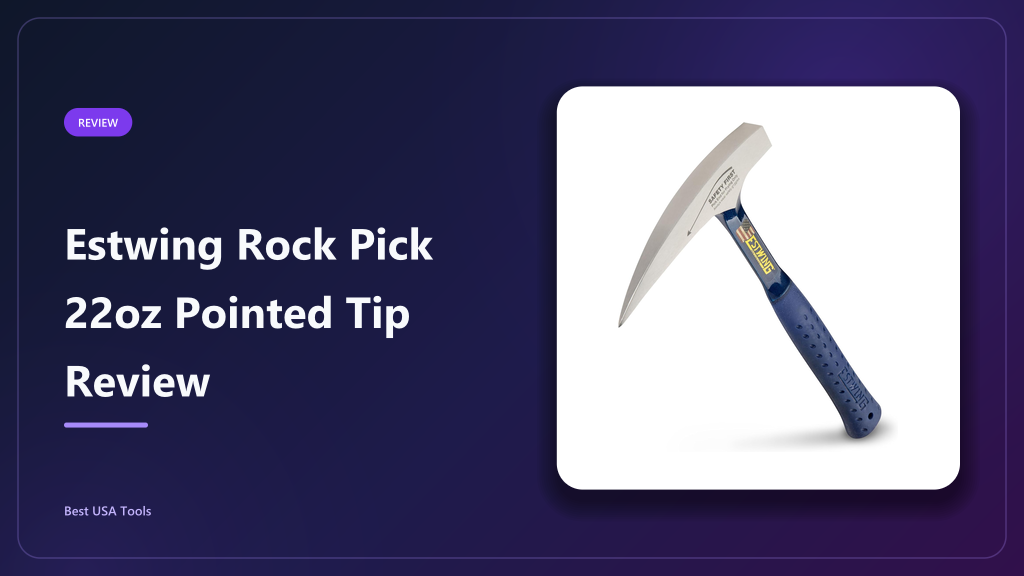
This ESTWING Rock Pick 22oz Pointed Tip review covers a tool that turns up in a lot of geology kits, and for good reason. It’s forged from a single piece of American steel and it carries a 4.8 out of 5 rating from more than 5,200 Amazon reviews. We’re a research desk, so everything here comes from the listing specs and what buyers report, not from swinging one ourselves.
The short version: it’s worth it if you want one tough, simple pick for rockhounding, fossil hunting or chipping hardpan, and you don’t mind a slightly heavier head. Skip it if you only break the odd stone in the garden or you’d rather have a lighter 14 oz tool. Here’s the full picture.

1. ESTWING Rock Pick 22oz Pointed Tip
Estwing has been making striking tools in Rockford, Illinois since 1923, and this E3-22P is the standard handle version of its best known rock pick. The listing pairs a square face with a sharp point, a forged alloy steel body and a molded shock reduction grip. Below we break down what those specs mean in the field and where the tool falls short.
What it is
A rock pick is a hammer-type tool that pairs a flat striking face with a tapered steel point for splitting and prying stone. The ESTWING E3-22P sits in the middle of that market as the standard handle version of one of the best known picks around, forged in Rockford, Illinois from a single piece of steel.
Around it you’ll find Estwing’s own Sure Strike line sitting lower on price, Vaughan and Collins selling comparable geological hammers with traditional handles, and a long tail of unbranded imports far below both. What separates this model is the molded shock reduction grip bonded straight to the steel core, which the manufacturer says cuts impact vibration by about 70%.
Setup and first impressions
Buyers writing about their first session describe a heavy, solid lump of steel with a neat blue grip and no rattle anywhere on it. The most repeated first impression is that it feels like a tool built to outlast the person holding it, which lines up with the one-piece forging.
A few practical notes come up again and again:
- The 22 oz head is heavier in the hand than photos suggest, and several buyers say the first ten minutes of swinging feels like a workout.
- The grip is comfortable from the first strike, with no break-in period needed.
- The listing includes only the hammer, with no sheath or lanyard, so a carry sleeve is worth adding to the order.
The point arrives sharp enough to bite into soft rock but not so fine that buyers worry about it curling on the first missed swing. Expect a light film of oil on the steel, which is normal for forged tools and wipes straight off. If you like learning tool handling in person, the workshops and hands-on sessions at the Midwest Tool Expo 2027 are a good place to try striking tools before you commit.
| Brand and model | Estwing E3-22P |
| Head weight | 22 oz |
| Item weight | 1.5 pounds |
| Head style | Square face with pointed tip |
| Materials | Forged alloy steel head and handle in one piece |
| Grip | Molded shock reduction grip, blue |
| Dimensions | 13 in long x 7 in wide x 1.25 in thick |
| Country of origin | Made in Rockford, Illinois, USA |
| Amazon rating | 4.8 out of 5 from 5,237 reviews |
| Best sellers rank | #15,864 in Tools & Home Improvement |
Day-to-day use
How the pointed tip handles rock and hardpan
A sharp point concentrates force into a small area, and that’s the whole idea here. Across the reviews we read, buyers describe it splitting shale, limestone and rock that holds fossils with short, controlled taps rather than big swings, and a few mention levering slabs apart with the point once a seam opens. Hardpan and packed gravel break up quickly too, which is why field geologists keep one on the belt.
On genuinely hard igneous rock it still takes repeated strikes. It’s a chipping tool, not a powered breaker, and buyers who expect sledgehammer results are usually the ones who mark it down. One drawback worth knowing: the point is aggressive, so it’s the wrong tool for trimming soft sandstone into neat blocks.
Square face, chisels and light prying
The square face is the part people underestimate. It drives a chisel or wedge cleanly because the surface is flat, and buyers report using it to open a crack before switching to the point. It’s also handy for tent pegs and survey stakes, which broadens the tool well beyond pure geology.
Because the face and grip come from the same forging, striking force travels straight down the handle instead of through a joint or a wedge. The trade off is the 13 inch overall length: it packs beautifully in a daypack but gives you less leverage than a long handle version, and Estwing does sell that as a separate 22 oz model.
How comfortable is the grip on long days?
The molded grip is the feature buyers praise most. Estwing bonds it directly to the steel core, so it doesn’t twist or slide, and the manufacturer claims a 70% reduction in impact vibration compared with bare steel. Reviewers with wrist and elbow complaints say the difference is noticeable after a few hours of chipping.
The blue surface holds well with dry or dusty hands. Where it falls short is mud: the grip has a fairly smooth profile, and a few buyers note that wet clay makes it feel slicker than they’d like. Gloves are still worth packing, especially for spring fieldwork.
Build quality and durability over time
One-piece forging means there’s no head to re-seat, no epoxy to fail and no handle to replace. Buyers report years of use without the head loosening, and the common wear points are cosmetic: scuffs on the blue finish and a point that dulls slowly and comes back with a file.
Forged alloy steel will rust if it goes away wet, so a wipe and a light oil after wet days keeps it tidy. The 1.5 pound overall weight is light enough to carry all day but heavy enough that a careless drop onto concrete can nick the tip. Neither issue is a dealbreaker, but both are worth a minute of care.
- Forged from one solid piece of steel, so there’s no joint to loosen
- Shock reduction grip bonded to the core, not pushed on
- Square face takes a chisel while the point splits rock
- Made in the USA and rated 4.8 out of 5 by more than 5,200 buyers
- 22 oz head balances striking force against control
- No sheath or lanyard included in the box
- 13 inch length gives up leverage to the long handle version
- Bare steel needs oiling after wet fieldwork
- Smooth grip gets slick with mud on your hands
Who should buy it
Buy it if you…
You collect minerals, split fossils or do field geology, and you want a tool that will still be in the bag a decade from now. Buyers who fit that profile are the core of those 5,237 reviews. It also suits scout leaders, teachers running a rock unit and anyone who wants one pick that handles chipping, prying and light chisel work without a joint to fail. If you’re assembling a wider kit, our guide to must have equipment for home and work covers the supporting items.
Skip it if you…
You only need to break the odd stone in a garden bed, where the 14 oz version is easier on the wrist. Skip it too if you want a long handle for leverage on big slabs, since Estwing sells the 22 oz head on a longer shaft as a separate model, or if your budget is tight, because imported picks cost less and cope with occasional use. And if you need a tool for digging rather than striking, a mattock is the better buy.
Alternatives to consider
If you want the same brand for less, the Estwing Sure Strike line uses a similar forged head with a plainer handle and a lower price. For a different feel, Vaughan and Collins both make geological hammers with hickory or fibreglass handles, which some users prefer for the extra length and traditional balance. Compare head weight first, then handle material, then price. The ESTWING wins on grip comfort and one piece construction, but a wooden handled pick can be re-shafted.
Frequently asked questions
Is the ESTWING rock pick good for beginners?
Yes, with one caveat about weight. The tool is simple: one end hits, the other pries, and there’s nothing to adjust beyond a wipe of oil. Beginners tend to like the grip because it forgives sloppy technique and takes the sting out of a missed strike. The caveat is the 22 oz head, which is heavier than the 14 oz version Estwing also sells. If you’re buying for a younger collector or someone with a weak grip, the lighter model may suit better.
Does the pointed tip work well on hard rock?
For chipping and splitting, yes. The point concentrates force, and buyers report it opening seams in limestone, shale and granite where a flat hammer just bounces. It won’t replace a chisel and sledge on really dense rock, and the manufacturer markets it for precise splitting and fossil extraction rather than bulk breaking. Short, sharp taps work better than full force swings, and that also protects the tip.
Is the handle comfortable for long periods?
Buyers consistently say yes. The molded grip is bonded to the steel core, and Estwing states it cuts impact vibration by about 70%, which matters most after the first hundred strikes. Reviewers who chip for hours at a time mention less hand and wrist soreness than they get from plain handled hammers. In wet or muddy conditions the fairly smooth grip gets slick, so pack gloves.
How does the ESTWING rock pick compare to a standard hammer?
A claw hammer is built for nails, and its hardened face can chip or mushroom when it hits stone. A rock pick has a forged point for splitting, a square face for driving chisels and a grip designed to absorb shock. Using a carpentry hammer on rock risks injury from a chipped face. If you already own a small sledge, the pick still earns its place for precision work in 2026.
Can this rock pick be used for landscaping?
Occasionally, yes, but it isn’t the best tool for it. Buyers use the point to pry out small roots and embedded stones, and the square face for tapping stakes. For digging beds or lifting paving, a mattock or a landscaping bar does the job with less wrist strain. Keep the pick for rock, and keep the digging tools for soil.
Final verdict
At 4.6 out of 5, the ESTWING Rock Pick 22oz Pointed Tip earns its reputation. The one-piece forging removes the failure point that kills cheaper picks, the shock reduction grip makes long chipping sessions kinder on the hands, and the square face adds chisel duty that a plain point can’t handle. It’s not perfect: there’s no sheath in the box, the 13 inch length gives up some leverage, and wet conditions make the smooth grip slick.
None of that outweighs the price, the American steel or the 4.8 star average from more than 5,200 buyers. If you want one durable pick for rockhounding, fossil work and hardpan, this is the sensible buy in 2026. If you only need light garden use, drop to the 14 oz model and save your wrist.
Affiliate disclosure: This article contains affiliate links. If you buy through them we may earn a commission at no extra cost to you. It does not change which products we recommend.