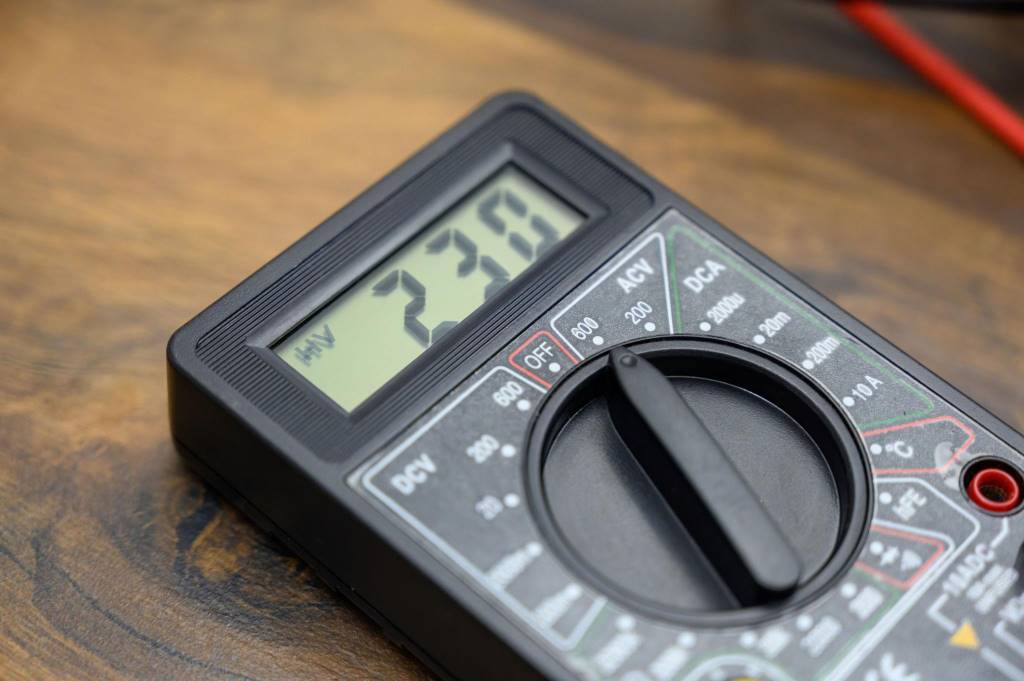
Electrical testing has become more demanding over the last decade. Modern vehicles, renewable energy systems, and compact electronics require tighter voltage tolerances and safer diagnostic practices. According to the U.S. Bureau of Labor Statistics, employment for electricians is projected to grow steadily through the decade, reflecting increasing demand for skilled electrical work. Meanwhile, the National Fire Protection Association continues to report thousands of electrical related fires annually, many tied to faulty wiring and improper testing.
That context matters. A reliable multimeter or electrical tester is not just a convenience. It is a tool that protects equipment, prevents downtime, and supports accurate diagnostics. In this guide, I review a range of the best multimeters, voltage monitors, battery meters, and specialized testers that professionals and serious DIY users rely on in 2026.
A Quick Overview of The Best Multimeter in 2026 for Professional Accuracy
The best multimeter models below cover automotive diagnostics, bench electronics, battery monitoring, and RF testing. Each serves a specific use case rather than trying to be universal.
- AUTOOL Automotive Power Circuit Probe Kit 6 to 24V Electrical System Tester
- DROK Digital 2 in 1 Voltmeter and Thermometer
- DROK Car Thermometer 2pcs Digital Voltage 10 to 170 Deg F Temperature Monitor Tester
- Klein Tools MM450 Slim Digital Multimeter Auto Ranging TRMS
- DC Multifunction Battery Monitor Meter 6.5 to 100V 0 to 100A LCD Display
- FNIRSI LCR P1 Transistor Tester Mosfet Transistor Capacitor Tester
- Neoteck 6000 Counts Digital Multimeter with NCV and TRMS Auto Range
- DROK Digital Multimeter DC 6.5 to 100V 20A Voltage Amperage Power Energy Meter
- CAMWAY Battery Monitor 8 to 120V 0 to 500A Voltmeter Ammeter Voltage Current Meter
- Astatic 302 01768 PDC7 Compact SWR Meter
- Neoteck 17PCS Multimeter Automotive Test Leads Wire Piercing Clip Puncture Probes
Best Multimeter of 2026
Choosing the right meter depends on what you measure daily. Some of these tools focus on full electrical diagnostics. Others monitor voltage and current over time. A few specialize in component level testing or radio frequency tuning. I tested them in workshop and automotive scenarios to understand how they behave outside a lab.
AUTOOL Automotive Power Circuit Probe Kit 6 to 24V Electrical System Tester
Automotive circuit tracing tool
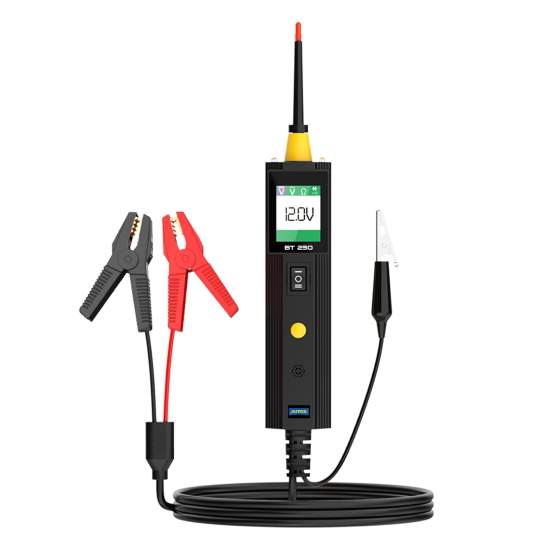
The AUTOOL probe feels purpose built for automotive diagnostics. It fits comfortably in one hand and includes long leads that make it practical inside engine bays and under dashboards. In real use, it simplifies tracing shorts, checking continuity, and identifying power sources without constantly switching between probes and meters.
It suits automotive technicians and advanced DIY mechanics who frequently work on 12V and 24V systems. I found it especially helpful when diagnosing intermittent lighting faults and relay issues. The audible indicators and power injection capability reduce guesswork.
It is not ideal for fine electronics or bench level circuit work. This is a field tool. Keep the probe tip clean and check the cable insulation regularly, especially if used around sharp metal edges.
User Review – Daniel R.
I work mostly on fleet vehicles. This tool cut my diagnostic time significantly when chasing parasitic drains. It does not replace a full multimeter, but for automotive systems it is much faster.
Key Features
• Power injection capability helps activate components directly to verify function without rewiring
• Extended cable length allows movement around large vehicles without repositioning constantly
• Audible polarity indicator reduces visual strain during quick checks
• Integrated circuit breaker protection protects the tool during overload situations
• Designed for 6 to 24V systems matches common automotive voltage ranges
Pros and Cons
| Pros | Cons |
| Speeds up automotive diagnostics | Limited to automotive voltage |
| Comfortable single hand use | Not suited for bench electronics |
| Clear polarity feedback | Cable can tangle |
DROK Digital 2 in 1 Voltmeter and Thermometer
Compact voltage and temperature monitor
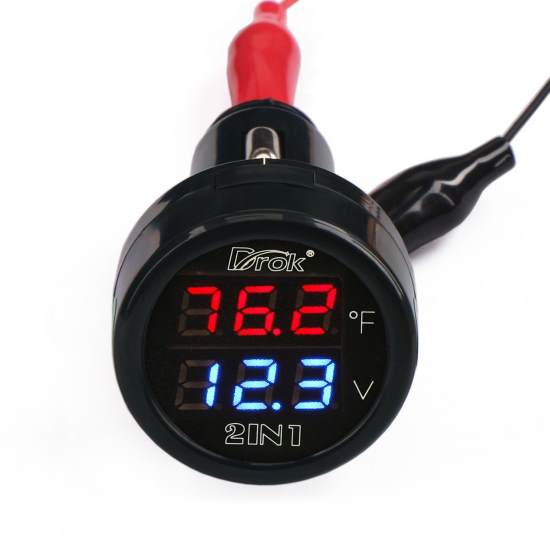
This small panel meter works well in custom dashboards and battery enclosures. The display remains readable in moderate daylight, and installation requires basic wiring skills. I installed it in a project vehicle to monitor auxiliary battery voltage and cabin temperature.
It suits hobbyists, RV owners, and anyone managing off grid setups. It continuously displays voltage and temperature without manual testing.
It is not a replacement for a handheld multimeter. It measures specific parameters only. Ensure proper mounting and avoid moisture exposure.
User Review – Melissa T.
I installed this in my camper van. It gives me quick reassurance about battery health and interior temperature during cold nights.
Key Features
• Dual display function shows voltage and temperature simultaneously for quick status checks
• Compact panel mount design fits tight spaces like dashboards
• Wide temperature range supports automotive and small enclosure monitoring
• Simple two wire installation reduces wiring complexity
• Continuous monitoring eliminates need for manual spot checks
Pros and Cons
| Pros | Cons |
| Compact installation | Not handheld |
| Clear dual display | Limited measurements |
| Good for RV use | Requires wiring knowledge |
DROK Car Thermometer 2pcs Digital Voltage 10 to 170 Deg F Temperature Monitor Tester
Dual vehicle monitor set
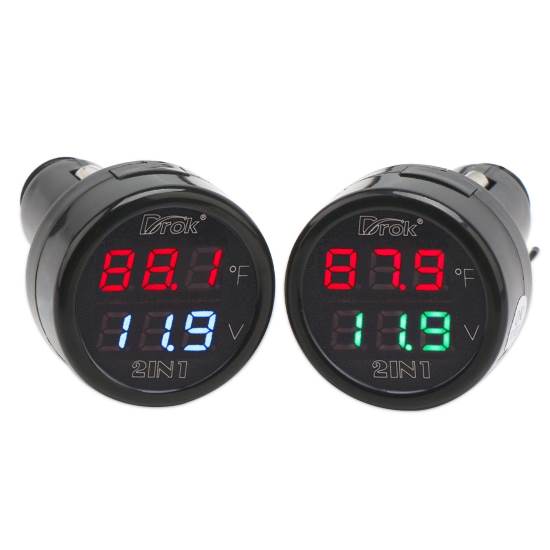
This two pack works well for front and rear cabin monitoring or separate battery compartments. The displays are simple but readable. Installation requires routing small sensor leads, which takes patience in tight interiors.
It fits drivers who want passive monitoring without pulling out tools. It performs well in cars, boats, and small enclosures.
Not suitable for precise lab measurement. Keep sensor wires protected from abrasion.
User Review – Aaron K.
I mounted one in my truck and one in my boat. It gives basic info at a glance, which is all I need.
Key Features
• Two unit package supports multi location monitoring
• Voltage and temperature display provides basic system awareness
• Low power draw design minimizes battery impact
• Compact digital screen fits small panels
• Broad temperature coverage useful for seasonal conditions
Pros and Cons
| Pros | Cons |
| Dual unit value | Basic accuracy |
| Easy to read | Not rugged |
| Good for vehicles | Limited functions |
Klein Tools MM450 Slim Digital Multimeter Auto Ranging TRMS
Professional grade slim multimeter
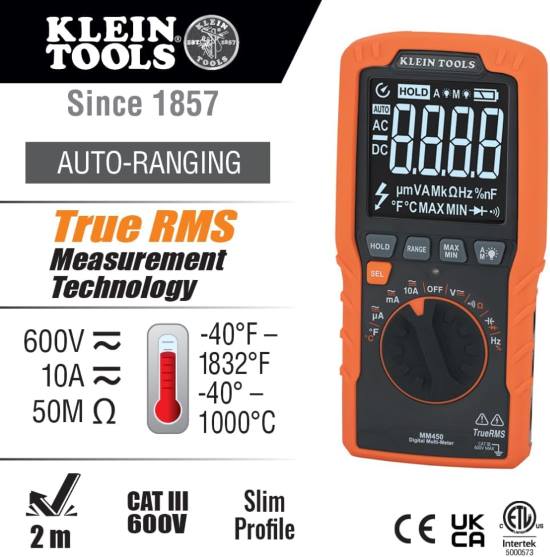
The Klein MM450 stands out for its slim profile and solid build quality. It feels durable without being bulky. The auto ranging True RMS measurement ensures accurate readings even on non linear loads such as variable frequency drives.
It suits electricians and HVAC technicians who need reliable daily performance. The display remains visible in dim lighting, and the controls feel deliberate rather than loose.
It requires routine battery checks and probe inspection. It is not the cheapest option, but it reflects professional expectations.
User Review – Carlos M.
I use this daily on commercial sites. It handles noisy circuits well and feels balanced in hand.
Key Features
• True RMS measurement ensures accurate readings on distorted waveforms
• Slim ergonomic body fits tool belts easily
• Auto ranging function reduces manual setting errors
• Backlit display improves low light visibility
• Robust casing design withstands job site handling
Pros and Cons
| Pros | Cons |
| Accurate on complex loads | Slightly heavier |
| Durable casing | Higher learning curve |
| Easy to read screen | Not pocket size |
DC Multifunction Battery Monitor Meter 6.5 to 100V 0 to 100A LCD Display
Battery performance tracker
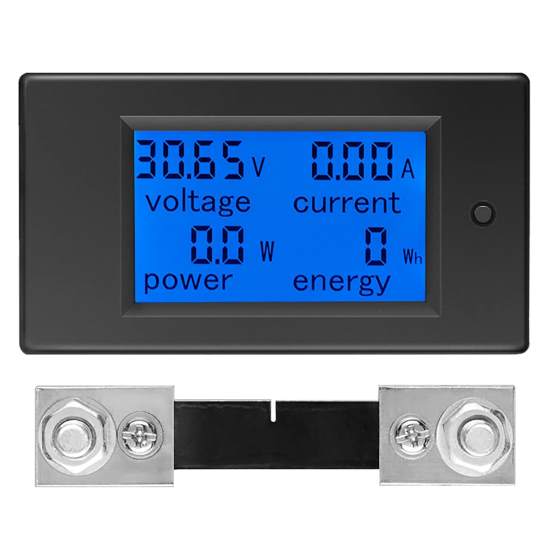
This meter monitors voltage, current, and power consumption in real time. I installed it in a solar backup system. It provided clear data on charging cycles and load behavior.
It suits off grid setups, marine systems, and battery banks. Installation involves shunt wiring, which requires careful placement.
It does not replace a handheld diagnostic meter. It functions best as a monitoring device.
User Review – George H.
I added this to my shed solar system. It helps me understand how much power I actually use daily.
Key Features
• Wide voltage range support works across many battery configurations
• Shunt based current measurement improves accuracy for load tracking
• LCD energy display tracks cumulative usage
• Continuous monitoring mode assists in long term system management
• Panel mount design integrates cleanly into enclosures
Pros and Cons
| Pros | Cons |
| Great for solar setups | Requires shunt wiring |
| Clear energy tracking | Not portable |
| Wide voltage range | Installation time |
FNIRSI LCR P1 Transistor Tester Mosfet Transistor Capacitor Tester
Component level diagnostic tool
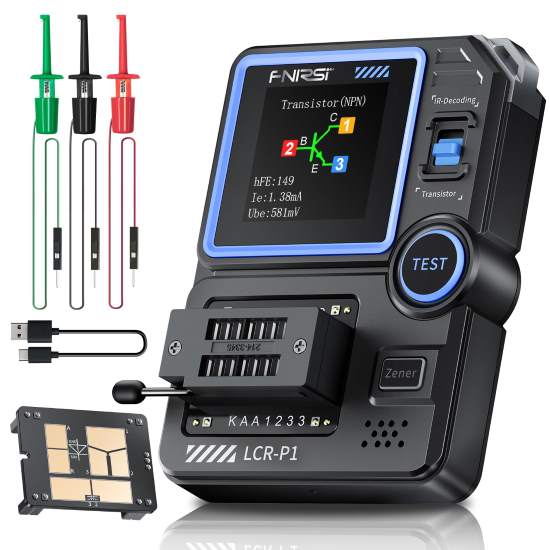
The FNIRSI LCR P1 focuses on electronic components rather than full circuits. It automatically identifies transistors, capacitors, and MOSFETs. On my workbench, it saved time during prototype troubleshooting.
It suits electronics hobbyists and repair technicians. It is not meant for high voltage circuits.
Keep leads clean and avoid testing charged capacitors.
User Review – Liam S.
For PCB repair, this tool saves me constant reference checking. It identifies parts quickly.
Key Features
• Automatic component identification speeds up bench diagnostics
• Clear LCD interface simplifies reading parameters
• Compact handheld format suits small workshops
• Broad component support handles common semiconductor types
• Simple single button operation reduces complexity
Pros and Cons
| Pros | Cons |
| Fast component testing | Not for high voltage |
| Easy to operate | Limited industrial use |
| Compact bench tool | Requires discharged parts |
Neoteck 6000 Counts Digital Multimeter with NCV and TRMS Auto Range
Versatile everyday multimeter
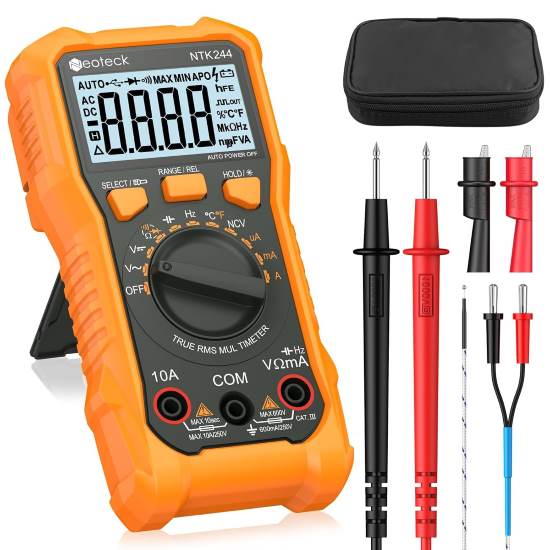
The Neoteck 6000 Counts model offers solid functionality for general electrical work. It includes non contact voltage detection and True RMS capability. In practice, it performs well for home wiring checks and appliance diagnostics.
It suits homeowners and entry level technicians. It is lightweight and comfortable to hold.
It may not match high end industrial meters in durability.
User Review – Priya D.
I use this for home projects. It gives accurate readings and feels easy to manage.
Key Features
• 6000 count resolution improves measurement detail
• Non contact voltage detection enhances safety checks
• True RMS support improves waveform accuracy
• Auto range function reduces manual setup time
• Compact build supports portability
Pros and Cons
| Pros | Cons |
| Good resolution | Moderate durability |
| Safety NCV feature | Not industrial grade |
| Lightweight design | Smaller display |
DROK Digital Multimeter DC 6.5 to 100V 20A Voltage Amperage Power Energy Meter
Inline DC energy meter
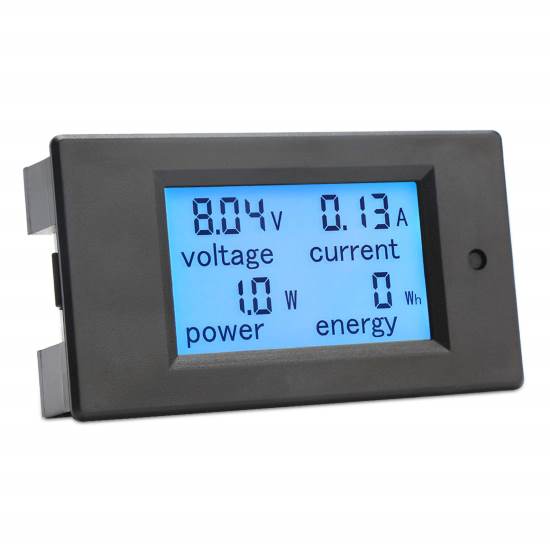
This meter integrates into DC systems to measure voltage, current, and energy flow. I tested it on a small lithium battery pack. It delivered stable readings during charge and discharge cycles.
It suits hobby solar users and battery builders. Installation requires wiring knowledge.
It is not designed for AC measurement.
User Review – Ethan L.
I installed it in my DIY power station. It gives reliable data without constant recalibration.
Key Features
• Inline current measurement tracks live system performance
• Energy accumulation display supports long term monitoring
• Clear LCD screen improves readability
• Broad DC compatibility supports varied battery setups
• Panel integration capability enables fixed installation
Pros and Cons
| Pros | Cons |
| Reliable DC tracking | DC only |
| Good for battery builds | Fixed installation |
| Clear digital readout | Wiring required |
CAMWAY Battery Monitor 8 to 120V 0 to 500A Voltmeter Ammeter Voltage Current Meter
Heavy duty battery monitor
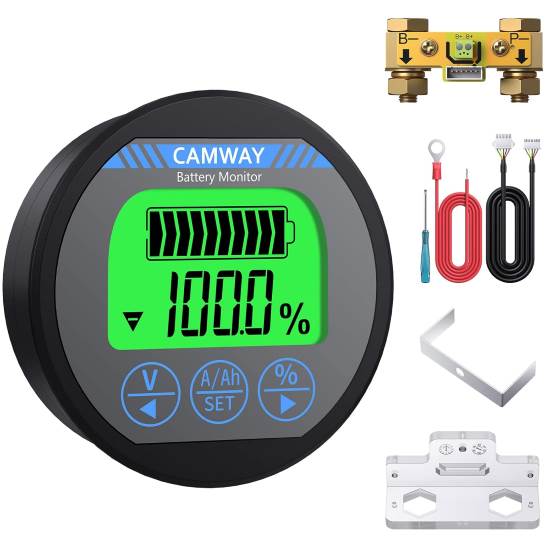
This unit handles higher current loads than most consumer monitors. I tested it in a larger battery bank setup. It provided stable readings even under significant draw.
It suits marine systems, RV installations, and high capacity backup systems.
It requires careful shunt placement and secure mounting.
User Review – Nathan B.
I installed it in my boat. It gives me confidence in my battery levels during longer trips.
Key Features
• High current capacity support handles demanding systems
• Wide voltage compatibility supports diverse battery banks
• Real time current display aids load management
• Panel mount format integrates into control panels
• Clear numeric interface simplifies interpretation
Pros and Cons
| Pros | Cons |
| Handles high current | Complex installation |
| Stable readings | Large size |
| Good for marine use | Not portable |
Astatic 302 01768 PDC7 Compact SWR Meter
Radio frequency tuning meter
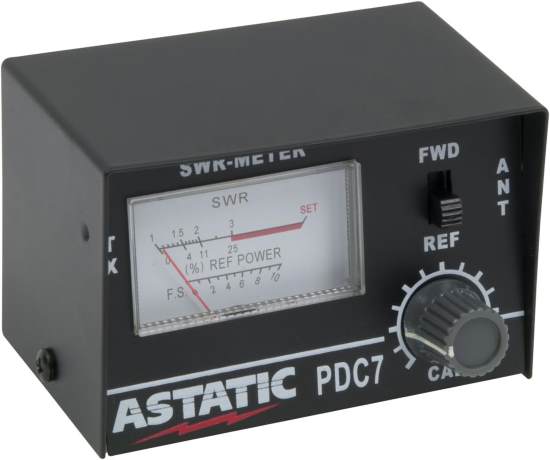
The Astatic PDC7 focuses on CB and amateur radio tuning. It measures standing wave ratio to protect transmitters. During testing, it provided consistent readings while tuning antenna setups.
It suits radio operators and hobbyists. It is not a general electrical multimeter.
Keep connectors clean and avoid moisture exposure.
User Review – Brian W.
I use it with my CB setup. It helped me dial in the antenna properly.
Key Features
• SWR measurement capability protects radio transmitters
• Compact metal casing supports durability
• Simple calibration controls streamline tuning
• Analog style display offers intuitive feedback
• Designed for CB systems fits radio installations
Pros and Cons
| Pros | Cons |
| Accurate SWR readings | Limited application |
| Durable housing | Not digital display |
| Easy antenna tuning | Radio specific use |
Neoteck 17PCS Multimeter Automotive Test Leads Wire Piercing Clip Puncture Probes
Comprehensive test lead kit
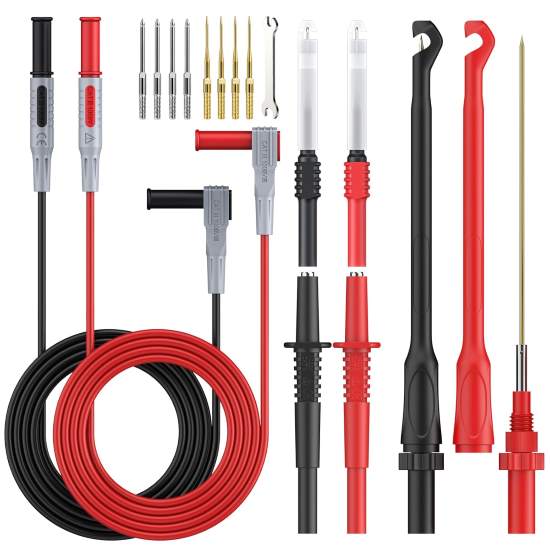
Test leads influence accuracy and convenience more than many users realize. This 17 piece set includes piercing probes and clips that simplify testing insulated wires.
It suits automotive technicians and DIY electricians. It expands the capability of existing meters.
Inspect tips regularly to maintain sharpness and insulation integrity.
User Review – Samantha J.
These leads made under dash testing much easier. I no longer struggle to reach tight connectors.
Key Features
• Multiple probe types included supports varied testing scenarios
• Wire piercing clips enable insulated cable testing
• Durable insulation materials improve safety
• Standard connector compatibility works with most meters
• Compact storage case keeps tools organized
Pros and Cons
| Pros | Cons |
| Expands meter capability | Tips wear over time |
| Good for automotive use | Requires careful handling |
| Organized storage case | Not a meter itself |
Buying Guide
Selecting the right electrical testing equipment requires more than checking a feature list. Long term satisfaction depends on how well the tool matches your daily work.
What Actually Matters Before Choosing
Core performance factors
Accuracy, resolution, and measurement range determine how reliable your readings will be. Many buyers focus only on maximum voltage rating. They overlook resolution and waveform handling. True RMS measurement matters when testing modern electronics and variable loads. Without it, readings may appear stable but misrepresent real conditions. Over time, inaccurate readings lead to misdiagnosis and wasted effort.
Material quality and durability
Casing strength, probe insulation, and internal fuse protection affect longevity. A meter dropped on concrete should continue functioning safely. Many assume all meters meet similar safety standards. They do not. Durability influences not only lifespan but also personal safety.
Usability and ergonomics
Button layout, backlight visibility, and probe flexibility shape daily comfort. A poorly arranged dial slows workflow. Buyers often underestimate how frequently they interact with controls. Small ergonomic frustrations compound over months of use.
Maintenance demands
Battery access, fuse replacement, and calibration stability matter. Some meters require frequent battery changes. Others hold calibration for years. Understanding maintenance effort helps prevent frustration.
Environmental compatibility
Consider temperature extremes, moisture exposure, and confined spaces. A panel mount battery monitor works well in an enclosure but fails as a portable tool. Buyers often ignore where they will physically use the device.
Safety considerations
Overload protection, insulated probes, and non contact voltage detection reduce risk. Many users assume safety only matters at high voltage. In reality, even automotive systems can produce dangerous arcs if mishandled.
Common Buyer Mistakes
Many assume the highest count display equals better performance. In practice, stability and calibration matter more than raw count numbers.
Some buyers choose automotive probes for bench electronics. That mismatch limits precision and can damage sensitive components.
Others purchase panel mount monitors expecting handheld flexibility. These devices serve continuous tracking, not diagnostic mobility.
A common error involves ignoring shunt installation requirements in battery monitors. Incorrect wiring leads to inaccurate readings and frustration.
Another mistake is neglecting lead quality. Poor probes introduce resistance and unstable readings.
Some underestimate future needs. They buy minimal functionality, then upgrade months later.
Finally, many ignore safety ratings. Proper category rating ensures safe operation in different electrical environments.
How to Match Products to Specific Needs
Casual users benefit from versatile handheld meters with auto ranging and non contact voltage detection. They value simplicity and portability over advanced analytics.
Heavy daily users such as electricians require durable casings, True RMS accuracy, and dependable overload protection. Long term comfort and reliability outweigh compact size.
Users working in tight spaces or vehicles benefit from slim profiles or automotive probe kits. Cable length and maneuverability become critical.
Budget conscious buyers focused on longevity should prioritize durability and safety rating rather than maximum feature count.
Advanced electronics users need component testers like the FNIRSI LCR P1 for bench work, combined with a reliable multimeter for broader circuit analysis.
Matching tool type to usage frequency and environment leads to higher satisfaction and fewer replacements.
Related:
Mastering the Multimeter: Your Guide to Continuity Testing
How to Test an Alternator with a Multimeter: A Comprehensive Guide
Conclusion
Electrical testing tools serve different purposes. A professional electrician, a solar hobbyist, and a radio operator each require distinct capabilities. Accuracy, safety, durability, and usability matter more than feature lists alone.
Choosing the right multimeter or monitor begins with understanding how and where you will use it. Evaluate measurement needs, installation environment, and long term maintenance expectations. With that clarity, selecting the right tool becomes straightforward.
FAQs
What is True RMS and why does it matter
True RMS provides accurate readings on non linear electrical loads.
Can I use an automotive probe as a regular multimeter
No, it specializes in vehicle circuits rather than full diagnostics.
Are battery monitors the same as multimeters
No, they track voltage and current continuously rather than test circuits manually.
How often should I replace multimeter leads
Replace them when insulation cracks or probe tips wear.
Is a higher count display always better
Not necessarily, stability and calibration accuracy matter more.